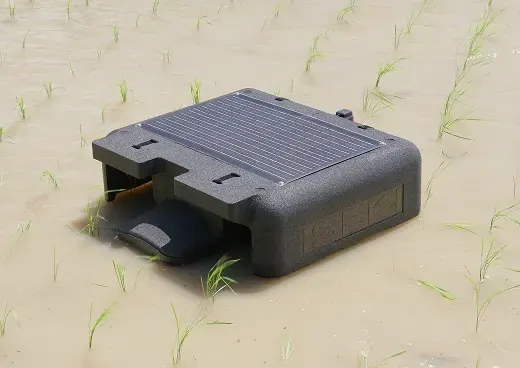
TYM Co. launched the Aigamo Robo in South Korea on 4 September 2026. The Herald Business and ChosunBiz both describe it as an autonomous, eco-friendly robot that copies traditional duck-farming weed control: instead of removing weeds that have already grown, an underside brush stirs paddy soil so the water clouds, sunlight is blocked, and settling mud covers weed seeds.
The Herald Business (4 Sep 2026) published these figures: 6 kg; primarily solar-powered; up to 10 hours a day; covers up to 15,000 square meters (1.5 ha). A GPS-linked smartphone app tracks the route, calls the robot back, sets work parameters, and includes an anti-theft function. Recommended use is the three-to-five weeks after transplanting. Once switched on, it navigates by detecting paddy ridges.
A two-year trial across 36 Japanese organic rice farms (Japan’s National Agriculture and Food Research Organization, Tokyo University of Agriculture and Technology, and Iseki Agricultural Machinery) cut average mechanical weeding sessions by 58% and raised yields by an average of 10% versus conventional organic methods, per The Herald Business. ChosunBiz separately reports a 2024 Japan demonstration that suppressed weed occurrence below the organic-cultivation target of 50 g/m².
A Chonnam National University paddy trial before the Korean launch compared robot-operated and non-operated zones. The Herald Business quotes Professor Oh Ju-seok (Convergence Biosystems and Machinery Engineering) saying suppression rose from 47.39% in week two to 74.91% in week three, with about 96% light-blocking and no weeds collected in operated test zones. ChosunBiz quotes the same trial figures under the name Oh Ju-seon.
TYM’s public product sites (tym.world / group.tym.world) describe the company’s tractor range and autonomous D.A.V.E. work; they do not publish a dedicated Aigamo Robo product page as of 25 September 2026.
Image: TYM-credited Aigamo Robo launch photograph published by The Herald Business. Source: https://biz.heraldcorp.com/article/10863020
Sources: