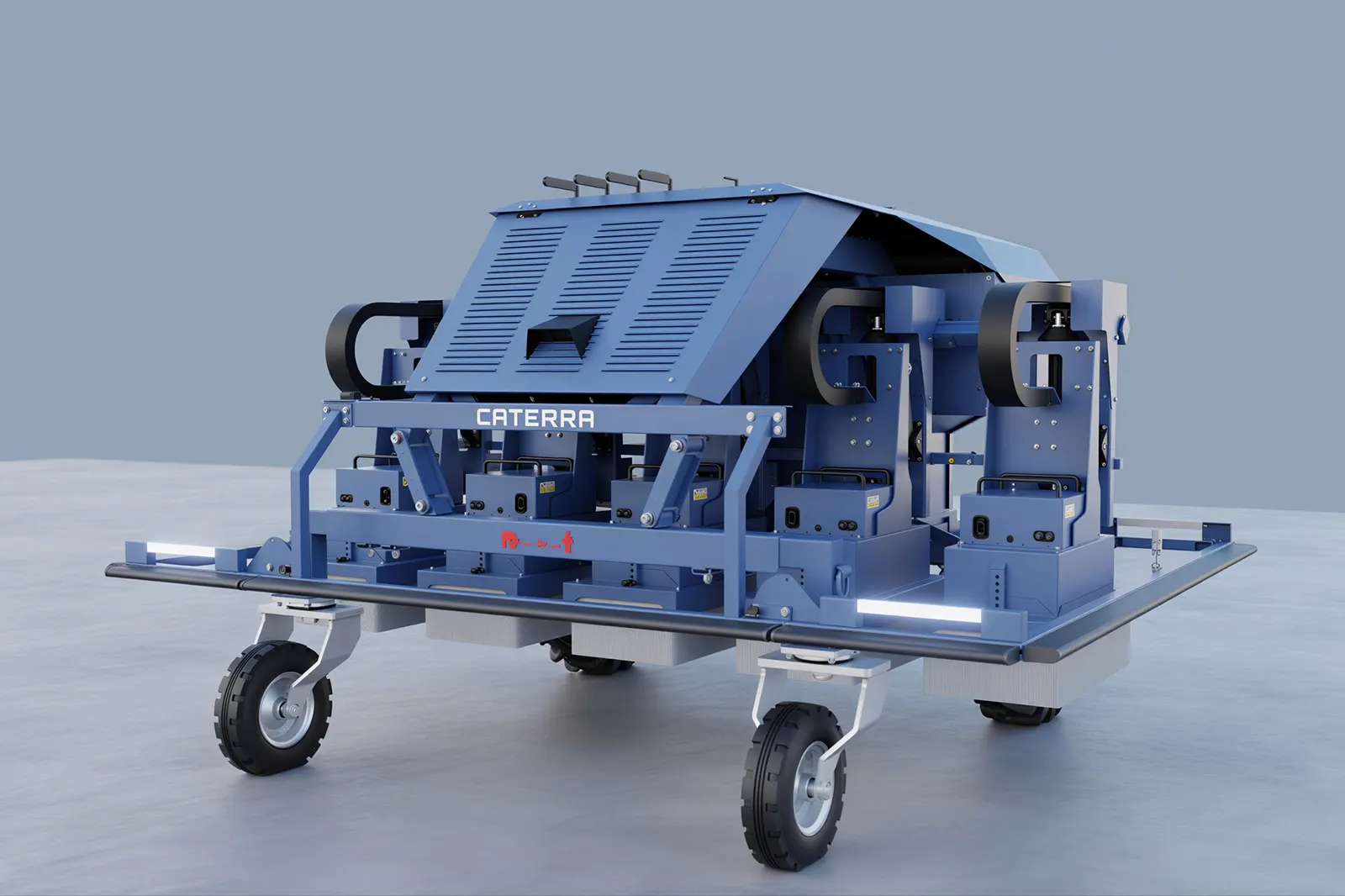
Caterra AG’s Honeybee is a fully autonomous electric laser weeder for organic and high-value vegetable crops. It is a separate model from Caterra’s smaller 2025 Grasshopper robots. Official site (accessed 2026-09-28): Caterra AG, Bäulerwisenstrasse 3, 8152 Glattbrugg, Switzerland; info@caterra.org. Current official domain is caterra.ch.
Laser weeding (Future Farming launch + Honeybee directory, photos credited Caterra AG). High-precision lasers with millimetre accuracy; weeds next to crop plants without physical contact. One laser module treats 0.3 m; up to five modules on the current configuration. Designed for very early crop stages until plants reach about 25 cm (0.25 m) height. Official Caterra FAQ: the laser targets weeds within 3 mm of the crop.
Capacity (Future Farming). In a standard carrot setup with a 1.5 m track width (4 dams, 3-metre treatment width), Honeybee can cover about 0.5 ha per 24 hours. Official FAQ: from 10 to over 200 hectares of vegetables is recommended; treat at least 15 hectares per year for a good return; several robots can work the same fields without overlapping rows or colliding.
Power and drive (Future Farming + official FAQ). Fully electric; two interchangeable battery sets; Caterra states around-the-clock work with one battery swap per day (nights and weekends included). Official: designed for more than 24 hours with one battery set; a second set is included; daily battery change plus laser-glass cleaning takes no more than 15 minutes. Two-wheel differential drive: two independent electric motor drivelines with fixed-ratio reduction gearboxes; steering by relative wheel speed (no mechanical steering). Self-contained: no hitch, PTO, or hydraulics. Total weight 1,300 kg.
Autonomy and safety (Future Farming). RTK GNSS follows predefined field maps. A camera in the laser module does real-time row detection. Certified for fully autonomous operation. Touch-based obstacle sensors stop the robot on contact with objects, animals, or people. Official FAQ: no active supervision required; monitor from the app; day/night, rain, and snow operation claimed.
Dimensions — record both published track-width wordings. Future Farming: 2.65 m long × 1.9 m high × 1.9 m wide (transport); track width 1.5–1.8 m; turning radius about 3–4.5 m. Official FAQ: track width 1.50–2.0 m (dams or beds). Those track ranges are not collapsed.
Pricing and fleet (Future Farming, accessed 2026-09-28). One-year lease €65,000 or purchase €220,000 in a four-laser configuration. Directory also prints USD conversions at the 16 February 2026 rate ($76,719 / $259,663) — those are Future Farming’s conversions, not a Caterra USD list price. Available in Switzerland and the EU; directory names current customers in Switzerland, Germany, the Netherlands, and France. As of 1 March 2026, nine Honeybee units operational in Switzerland and the EU; 11 smaller Grasshopper robots released in 2025 to be redeployed. Directory: development start 2022.
Official testimonials (caterra.ch, not treated as specs). Stefan Brunner (weeding contractor, Aarberg); Georges Vuillod (farm owner, Geneva); Tabea & Miro Weber (farm managers, Neunkirch; one Grasshopper saves about two people); Roman Dünner (farm owner, Neuwilen).
Image: Caterra AG product photograph of Honeybee (labeled CATERRA) via Future Farming (1-Caterra-Honeybee_web.jpg). HTTP 200 on 2026-09-28.
Sources: