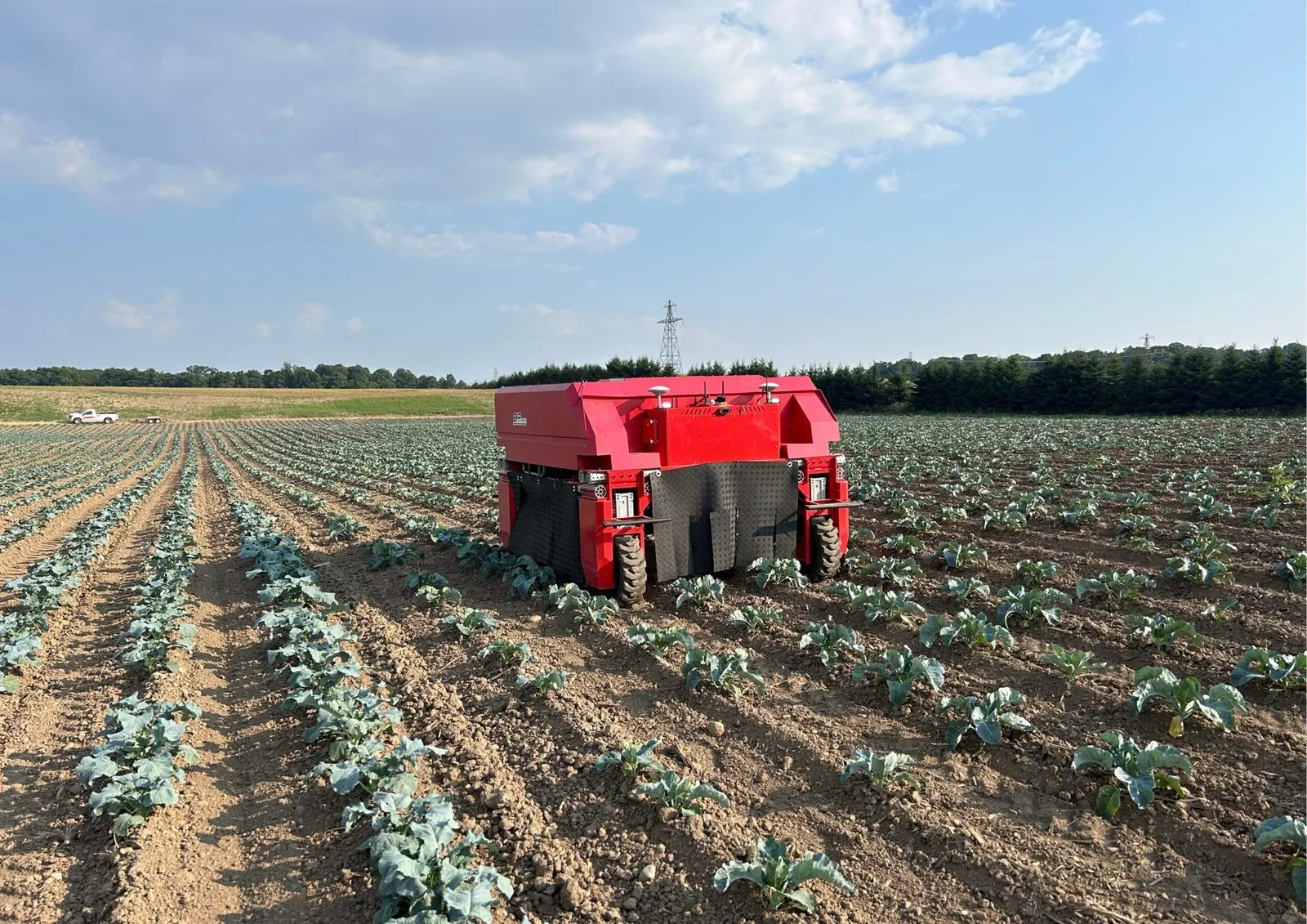
BHF Robotics’ Blitz ElectricWeeder™ uses AI deep-learning vision to identify weeds and crops in real time, then high-power electricity to kill weeds and to thin crops. The official electric-weeder page says it works for conventional, organic, and no-till farming, with no hand labor, chemical herbicides, or mechanical soil disruption. It operates above the soil surface and does not penetrate the ground. Official sales office: 160 Gibson Dr., Markham, ON L3R 3K1. Email: info@bhfsolution.com.
Official company claims (bhfrobotics.com/electric-weeder/). 3D deep-learning vision model; high-resolution industrial cameras; covers up to 3 acres per hour; sub-millimetre targeting accuracy; kills 99% of weeds; operates 24/7 (day and night), in all conditions. A later “physical specs” block on the same page says millimeter-level targeting precision — both wordings are recorded. Available in autonomous and tractor-implement configurations. Liftable weeding implement with 5–20 ft working width. Payback period of 3–18 months. Crops named: lettuce, carrots, onions, beets, peppers, strawberry, and “many more”; also mulch-grown strawberries and muck (black) soil. Company also claims it is faster than any commercial non-chemical weeder, works on all weeds at any growth stage and in all soil types, and cuts weeding costs by up to 95%. Another official line claims the system is 60 times more energy efficient than laser weeding and chemical weeding.
Farmtario field demo (published 23 July 2025). Kristy Nudds reported a Bradford AgRobotics event at the Ontario Crops Research Centre. Tech entrepreneur David Tao, CEO and co-founder of Ontario-based BH Frontier Solutions, presented a compact BHF ElectricWeeder: an autonomous robot that selectively kills weeds with high-voltage electricity, guided by AI using an integrated multi-camera algorithm. The article describes a 1.2 tonne Ontario-made, weather-resistant autonomous robot that uses crop-based modelling, not weed-based. Tao: algorithms are trained to recognize the crop; anything different is considered a weed; the crop model trains with 100 images, with shape and morphology changes requiring additional training. The 1.2-ton machine can weed up to 10 acres an hour and operate in most weather 24/7; mud can be problematic. Configurations named there: autonomous, tractor-pulled, and tractor-liftable; coverage five to 20 feet; swath widths of 60, 120, and 240 inches; adjustable row spacing of 60 to 88 inches. Sub-millimetre precision and 99 per cent weed kill; more efficient than a 100-person hand crew (Tao). US$150,000 commercial versions “will ship near the end of the year” (Tao, as quoted). That 10 acres/hour demo figure and the US$150,000 price are Farmtario/Tao — they are not collapsed into the official page’s up to 3 acres per hour claim, and the official page publishes no price.
Reservoir Farms resident (sourced). Reservoir’s 10 April 2026 news item (Salinas opening dated 17 March 2026) lists BHF Robotics in the initial Reservoir Farms – Salinas cohort, alongside other resident startups. That is the citation used here for residency.
Image: official BHF Robotics field photograph (robot-field-2-scaled.jpg on bhfrobotics.com/electric-weeder/; red autonomous weeder in a brassica field). Not the Gen 3 marketing composite and not a Farmtario still (press photo by Kristy Nudds exists at farmtario.com but the official machine image was used).
Sources: