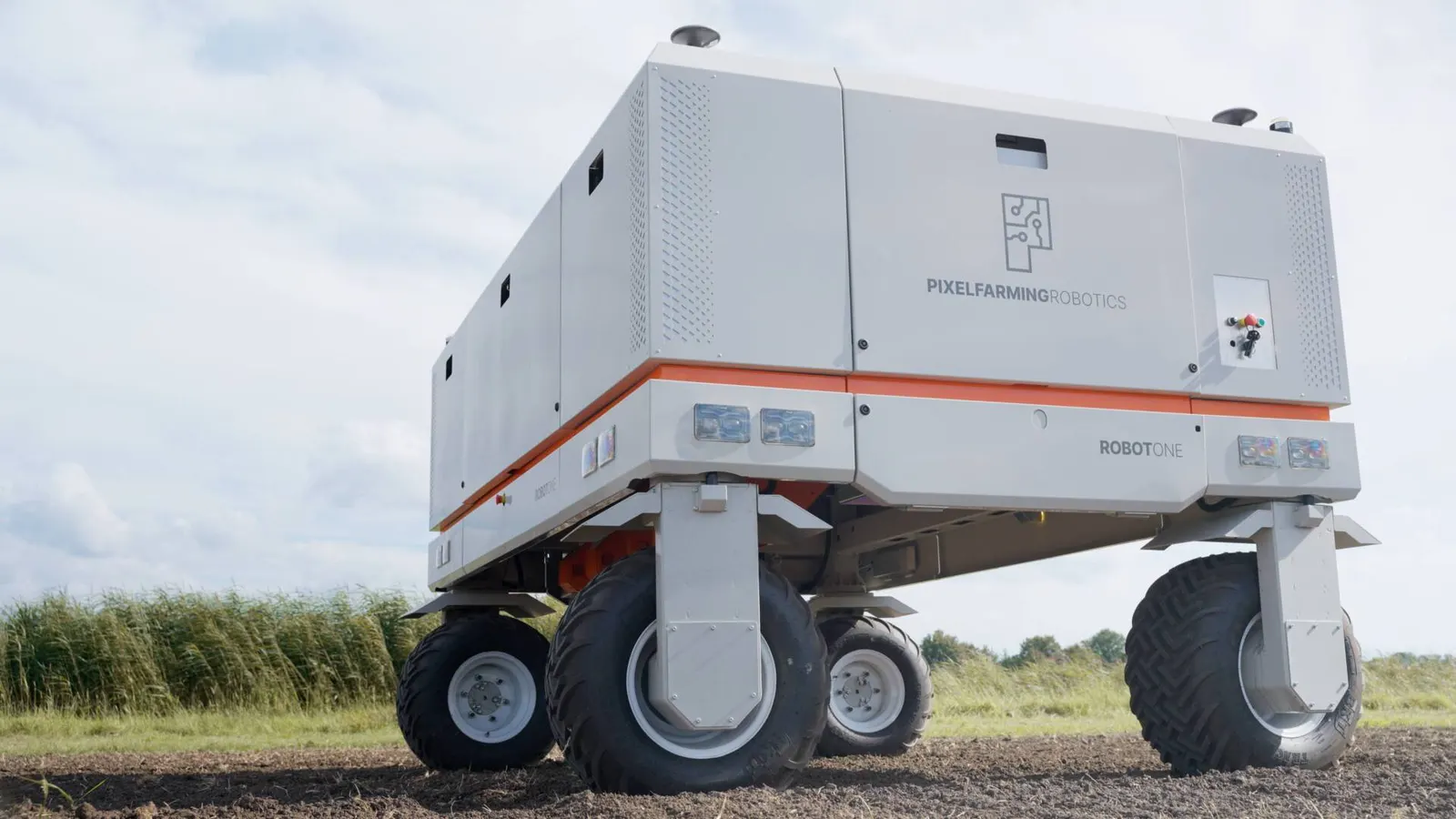
Pixelfarming Robotics’ Robot One is an autonomous laser weeding robot. Official contact page: Laagt 16, 4286 LV Almkerk, Netherlands; info@pixelfarmingrobotics.com; KVK 77103491. Arend Koekkoek is listed as CEO | Founder.
How the laser is described (official pages). The Robot One page: high-power laser modules use a concentrated beam to create an exothermic reaction that heats plant cells until they burst; “boiling it from inside out.” Most effective in the two-leaf stadium of the weed (energy use versus detectability). The dedicated laser-technology page defines a laser unit as a CO₂ laser tube, targeting mechanism, cooling, and electronics; a row of lasers is a laser module, with the number of single lasers depending on machine configuration. That page explains a carbon-dioxide laser as a high-voltage-charged gas mix that amplifies infrared light between mirrors. FAQ on the product page: Robot One with lasers is not designed for large, overgrown weeds; burning a mature plant is described as inefficient.
Crops named on the official Robot One page: spinach, onion, babyleaf, leek, chicory, fine herbs. Modular design for different track widths and heights.
Scan / train / act (company process). Scan the first 100 m of a field; images go over Wi-Fi to Pixelfarming Academy; the grower labels species and trains a plant model; then the robot drives at a set pace and steers lasers at plants labelled as weeds. Open plant detection: the company says growers own the models and data they collect. Two-year onboarding after delivery, ending in an exam that certifies the operator for that configuration. Implementation steps on the page include scanning at the early two-leaf stage, labelling, sowing a follow-up cultivation about two weeks later to validate models, then lasering.
Track widths (official product page). Wheel units turn 360 degrees. Robot One 3.60 m: inward 3.20 m; inward/outward 3.40 m; outward 3.60 m. Robot One 6.20 m: inward 5.80 m; inward/outward 6.00 m; outward 6.20 m. Transport / length mode: inward 1.80 m; inward/outward 2.00 m; outward 2.20 m. All configurations can enter transport mode, “reducing the total width to only 246 cm.” 3.60 m config is described as trailer-towable behind a utility van or pickup; larger models need a larger trailer.
Powertrain (official product page). Solar panels on the roof recharge batteries on sunny days and “deliver enough energy to power the robots driving and computing systems”; panel count depends on configuration. Full-electric drivetrain, power on all four wheels, high torque for challenging soils. Energy from four 48 V rechargeable batteries; charger on standard 220–230 V outlets. For operations with multiple lasers, a diesel range extender is recommended so batteries charge while working. The range extender is a small diesel engine with a large fuel tank integrated on the frame (“aside from its exhaust it will not be visible from the outside”). Default tires: section width 245 mm, size 9.5-16, BIAS construction. Large tire option: section width 295 mm, size 300/70 R 20.
Autonomy (official product page). GPS and RTK; field defined with four corner markers; geofences in Pixelfarming Academy. “To operate autonomously, we require that there should always be supervision by a qualified operator.” Regulation “differs per region.”
A Robot One brochure PDF exists at a real site URL (/wp-content/uploads/2025/02/Robot-One-Brochure-20250131-Website.pdf, 20 pages). This drip opened that file but could not extract a readable spec table from it (image-heavy). No brochure numbers are used here. Two grower-testimonial cards on the product page are lorem-ipsum placeholders and were ignored. Official product pages opened for this drip do not publish a euro price.
Future Farming directory (Robot One – V2025; opened 2026-09-26). “Robot One’s 2025 focus is laser-only, with pricing starting at €355,000 for a 3.60 m machine equipped with 10 laser arms.” A 6.20 m machine “can be equipped with up to 46 laser modules (Pricing on request).” Development start is given as 2018, “new design from 2024.” Those figures are Future Farming’s V2025 listing, not an official Pixelfarming price list.
Image: official Pixelfarming Robotics Robot One product photograph from pixelfarmingrobotics.com/robot-one/ (Robot-One-24-Image.jpg; machine labeled PIXELFARMINROBOTICS / ROBOTONE). Source: https://pixelfarmingrobotics.com/robot-one/
Sources: