TopFarmRobots · Farm robots, weekly · Week of October 12, 2026
Hi there,
Welcome to issue three. Quick intro if you're new: I'm Carl Lippert, a farm owner and technologist. Keeping up with farm robots is my side project, and this newsletter and topfarmrobots.com are where I share what I find.
Thanks to everyone who answered last week's question. Replies came from investors watching Sami Robotics and Carbon Robotics, so this week's spotlight is Carbon.
The rest of the week is about machines that keep working with nobody on board: a tomato harvester built to run 22 hours a day, a citrus sprayer that one person can run four at a time, and one farmer's running costs after five years with two spraying robots.
This week's question. Hit reply with just a number: what should I cover more of?
1 – harvest and greenhouse robots
2 – weeding and spraying robots
3 – orchard and vineyard robots
4 – funding and company news
Bonus points: name the robot maker you'd like me to spotlight next. I read every reply.
New on TopFarmRobots
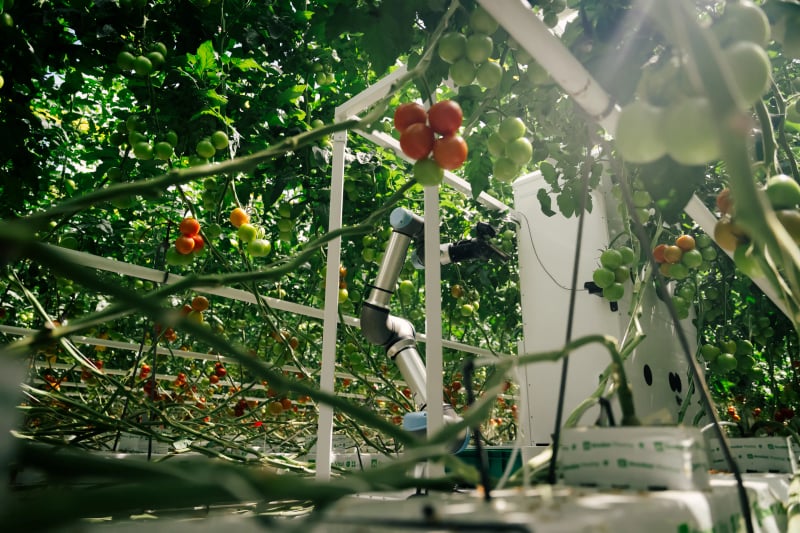
eternal.ag Harvester
A truss-tomato harvesting robot from eternal.ag, a German startup, built for high-tech greenhouses. The company says it needs no operator, works up to 22 hours a day, cuts up to 120 trusses an hour, and switches lanes on concrete floors by itself. HortiDaily reported on Oct 9 that it is now being demonstrated at Tomatoworld, a greenhouse showcase in the Netherlands.
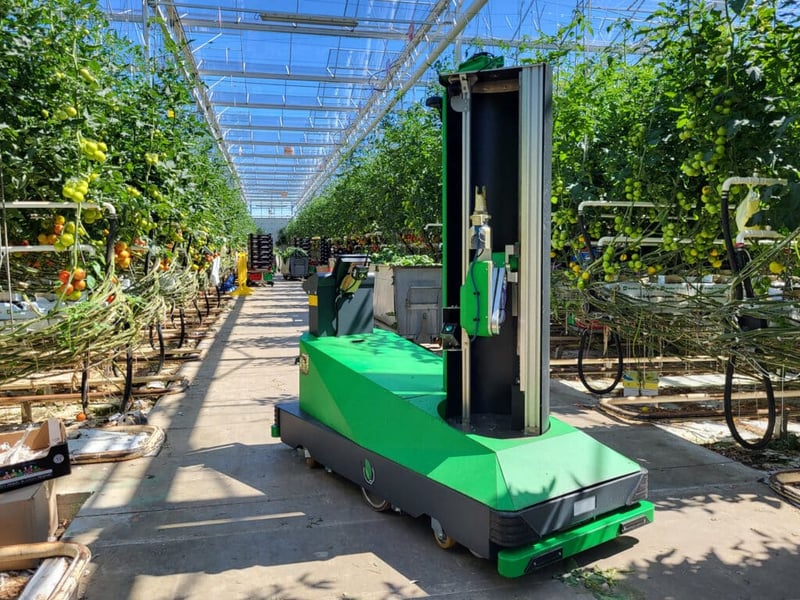
Aisprid D01
A tomato deleafing robot from French company Aisprid, which now calls it Leafy. It works along the greenhouse rails, strips leaves between 0.8 and 2 metres up, and changes rows on its own. Aisprid lists 20 hours of work per charge on a lithium battery and up to 2.5 hours to recharge, and says that on many farms growers hand it up to 80% of their deleafing.
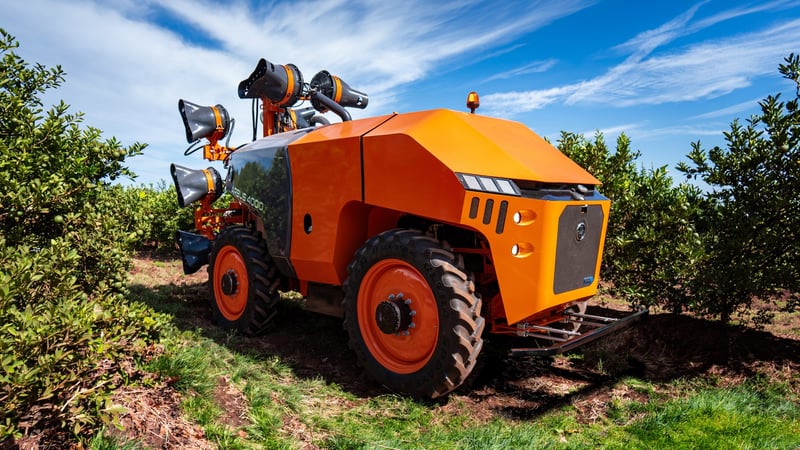
Jacto Arbus 4000 JAV
A cabless, self-driving orchard sprayer from Brazil's Jacto, built first for citrus. It ran on rental contracts on citrus farms before going on sale at Agrishow 2026 in April. Jacto says it logged more than 16,000 hours on almost 60,000 hectares before launch, that one person can supervise up to four machines in a convoy, and that each can spray more than 1,000 hectares a month running around the clock.
Company spotlight: Carbon Robotics
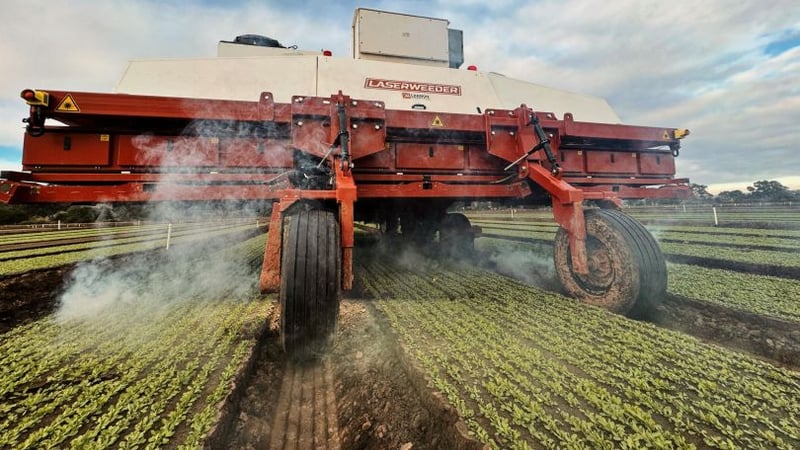
Carbon Robotics was founded in 2018 in Seattle by Paul Mikesell, who earlier co-founded the data storage company Isilon. It sells two things: the LaserWeeder, a tractor-pulled implement that uses cameras and AI to find weeds and kill them with lasers instead of herbicide, and Carbon Autonomy, a kit that lets John Deere 6R, 8R, 8RX, and 8RT tractors (2019 and newer) drive themselves. Its website says more than 200 growers in 15 countries use its machines.
Mikesell told AgFunderNews in late August that Carbon passed $100 million in revenue in the year to March 2026, and that the goal is an IPO. He also said the company is building a new machine it hasn't announced yet, and may raise more money for its tractor autonomy line after a $20 million Series D extension.
Two more details. Mikesell said LaserWeeder payback is under three years, with the fastest under one year, and that banks now write operating leases on the machines because they see resale value. And at the Farm Progress Show in September, Carbon launched Carbon Autonomy Ready, a spec that lets implement makers plug into its self-driving tractors. Great Plains, a Kubota company, is the first member: the tractor reads and adjusts depth, down pressure, and leveling the way an operator would.
Recent founder talk: on the Shift AI podcast (Sep 17, 2026, about 35 minutes), Mikesell talks with host Boaz Ashkenazy about replacing chemical weed control with lasers and autonomy, and about the plant model Carbon built from 150 million plant images. Watch on YouTube
In the news
hexafarms raises €4.8 million (Oct 6). The Berlin company sells greenhouse growers wireless sensors, yield forecasts, and robots that scan every plant every day across two to three hectares, looking for early signs of pests and disease. Ananda Impact Ventures and Green Generation Fund led the seed round. Growers pay a subscription and hexafarms installs and maintains the hardware; it says more than 50 growers in 13 countries use it.
Why it matters: It's the opposite bet from last week, when Greenfield and Antobot moved growers from renting robots to owning them. hexafarms · On TopFarmRobots
BloomX raises a $13 million Series A (Oct 8). The Israeli company pollinates orchards with machines, using its YAHAV2400 platform. Elah Fund led the round, joined by Rothschild, OurCrowd, and Sadot, the agtech fund of Israel's Granot Organization. Three kibbutzim, Magal, Horashim, and Eyal, invested separately and plan to be early users of the machines.
Why it matters: The money goes to more crops, new countries, and selling pollination as a managed service rather than only as equipment. Dealroom · On TopFarmRobots
One farmer's numbers after five years with SwarmBots (Oct 8). Future Farming talked to Tom Coggan, who runs two SwarmFarm SwarmBot 5 spraying robots on a 26,300-hectare (65,000-acre) mixed farm in Australia. Each has about 7,500 hours. With an 18-metre boom and WEED-IT spot-spray cameras, he reports about 13 hectares an hour. His costs per robot: about A$1,000 per service, a A$12,500 yearly software subscription, about an hour of labor a day, and 4–7 litres of fuel an hour. He estimates operating costs are about 70% lower than conventional spraying (his own estimate, Future Farming notes), and says he would buy them again.
Why it matters: These are running costs from a farmer, not the maker, including the yearly software fee. Future Farming · On TopFarmRobots
Worth watching
Ag Tech Talk: The Practical Path to Farm Automation, with Burro's Charlie Andersen
Charlie Andersen, CEO of Burro, on AgriBusiness Global's Ag Tech Talk podcast (Sep 10, 2026). Drawing on Burro's experience deploying more than 800 autonomous systems, he argues growers should start robots on simple, repetitive jobs before harder ones, and talks about how to tell companies built for real farm use from ones built for demos.
Listen to the episode · Burro on TopFarmRobots
Coming up
Farm Robotics Challenge 2027 · Teams register by Nov 13
A student competition run by UC ANR Innovate and the AI Institute for Next Generation Food Systems (AIFS). Teams work with growers to design and field-test robotics and AI projects, with final projects due May 2, 2027. It's open to students at 2- and 4-year colleges, universities, and trade schools, plus US grades 7–12. There's more than $200,000 in prizes and startup support, including a possible $100,000 investment from Reservoir VC for the top startup-track team.
Also next week: FIRA USA (Oct 20–22, Yakima, Washington) and RoboBusiness (Oct 20–21, Santa Clara, California).
How to take part · 2027 season details (UC ANR) · All upcoming events
Don't forget: hit reply with 1, 2, 3, or 4 (and the company you'd like spotlighted). It takes five seconds and tells me what to cover. — Carl
Building a farm robot? Submit it to the catalog with the "Submit a robot" button at topfarmrobots.com.