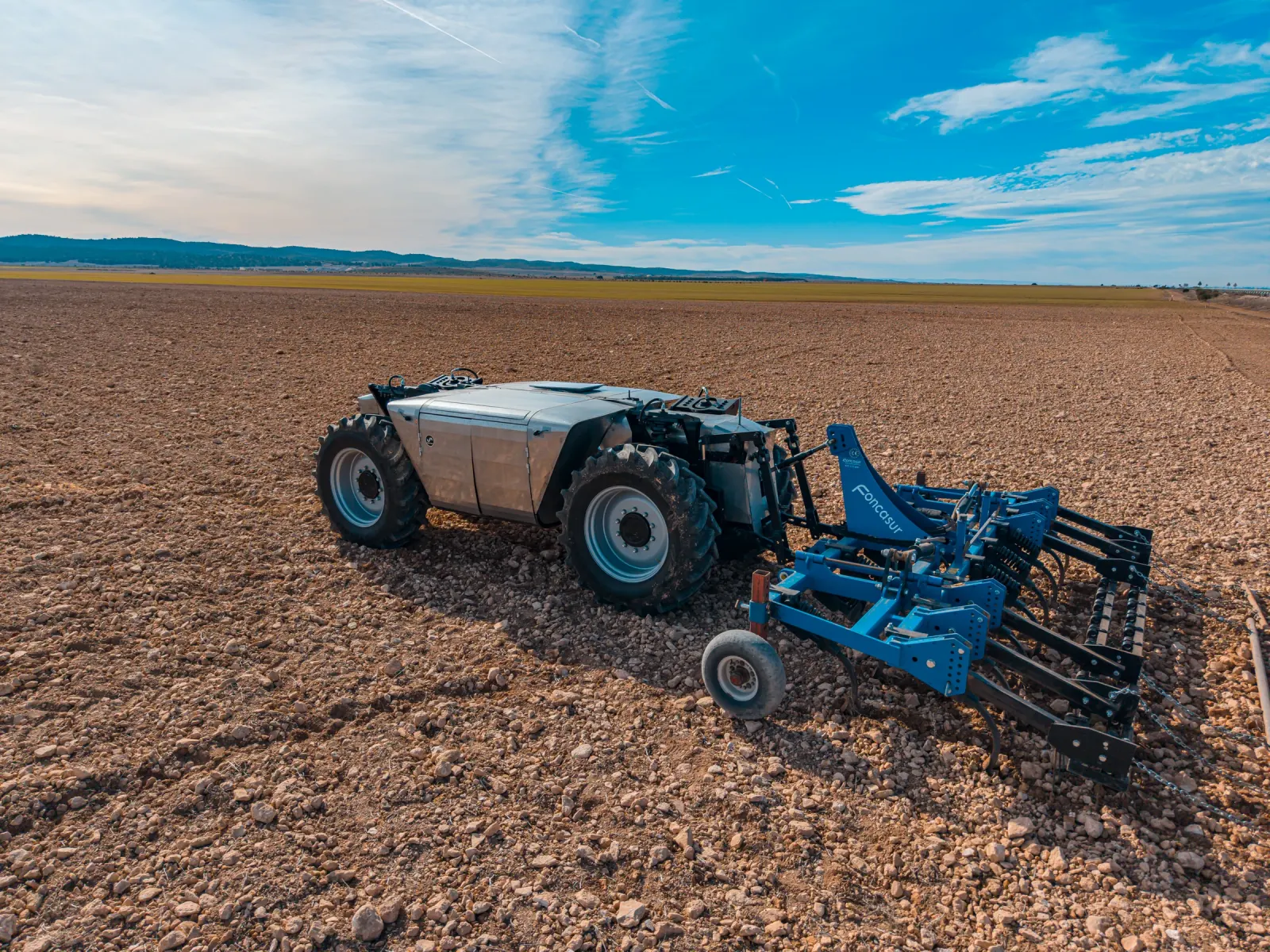
Cabinless autonomous electric tractor/platform from Valencia. Four in-wheel motors (4 × 27.5 kW / 150 HP), swappable batteries, standard three-point hitch. Thor 2 is pre-serial; Thor 3 is planned as the first production-ready version.
Specifications describe this model and its listed configuration. Read operating notes for limits and qualifications. Listed figures are manufacturer or press claims, not independent verification of current availability.
Farm robots, weekly
Three farm robots, one company up close, and the week's funding and news, with sources. Free, weekly, from a farm owner. Latest issue →
Thor 2 is pre-serial (shown in Berlin); Thor 3 planned as first production-ready unit. 96/year Valencia first phase. Swappable packs up to 20 h. Co-founder Francisco Infante Aguirre.
Voltrac’s Thor is a cabinless, driverless electric agricultural vehicle built in Valencia. The official site lists: max speed ~40 km/h; power 4 × 27.5 kW (150 HP); range 8–20 h; 200 kWh for 8 h of plowing and 20 h of driving, with swappable batteries; unladen weight ~3,500 kg; rear hitch 3,000 kg; front hitch 1,000 kg; rear PTO 1,000/540 rpm eco (front PTO optional); hydraulic pump 73 L/min; total length 4.5 m; wheelbase 2.2 m; height 1.60 m; ground clearance 0.5 m; tires 380/85R28; 4-wheel drive and steer; dual SIM plus Starlink; 360-degree cameras; local joystick/controller plus software.
Thor 2 was demonstrated at a robotics event in Berlin and is a pre-serial vehicle; Thor 3 is intended as the first production-ready version. First-phase manufacturing is 96 units per year at a 1,200 m² Valencia factory, with a longer-term blueprint of 1,000 vehicles per year. Co-founder Francisco Infante Aguirre said electrifying removes gearbox, oil filters, and radiators, leaving about 70% fewer components than a traditional tractor. One motor per wheel with a reduction box is reported at 20,000 Nm wheel torque. GPS precision is given as around 5 centimetres. One operator is meant to supervise multiple vehicles. The three-point hitch is intended to take implements a farmer already owns.